Investors and financial analysts
Portfolio screening
Compare disclosure quality, transition plans, and source evidence across companies using your own sustainability criteria.

Open core AI toolkit
Move from one-off AI prompts to structured analysis with traceable source passages, configurable assessment frameworks, and repeatable quality checks.
Try OSA now!From general-purpose AI to a professional workflow
Tools like ChatGPT or Claude can answer questions from a report. Professional analysis also needs to find the relevant passages, show how each answer was produced, and give human analysts enough transparency to review and sign off the results. OSA adds that structure without replacing expert judgement.
Portfolio screening
Compare disclosure quality, transition plans, and source evidence across companies using your own sustainability criteria.
Disclosure review
Review ESRS, CSRD, TCFD, and client-specific disclosures with traceable sources and a method that can be reused.
Benchmarking and supplier risk
Benchmark reports, assess climate, nature and human-rights disclosures, or build transparent research datasets.
Use your own questions, retrieve the relevant passages, review the evidence, and export results ready for analyst sign-off.
From PDF upload to reproducible evaluation, OSA keeps the full analysis workflow under your control.
Analyze a single sustainability report or batch-process a collection of PDFs.
Start with TCFD and ClimRetrieve question sets, or bring your own YAML framework.
Choose the model, processing stage, chunk size, overlap, retrieval depth, and scoring.
Download answers and chunks as structured data, then compare reports and configurations.
See it in action
Configure the assessment, review its analysis and selected chunks, verify the highlighted source evidence, and calculate performance against a benchmark.
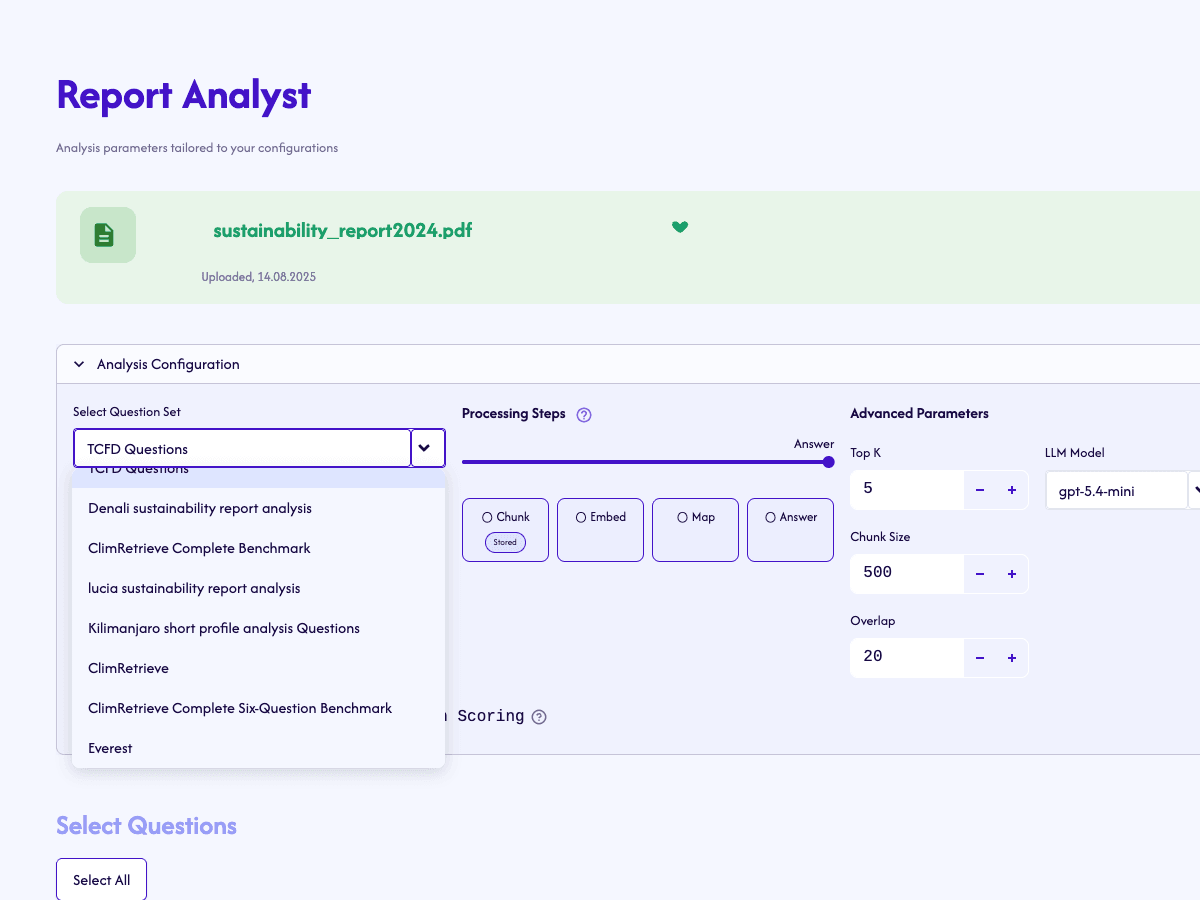
Choose an assessment framework, model, and processing stage. Set chunk size, overlap, retrieval depth, and scoring before the run.
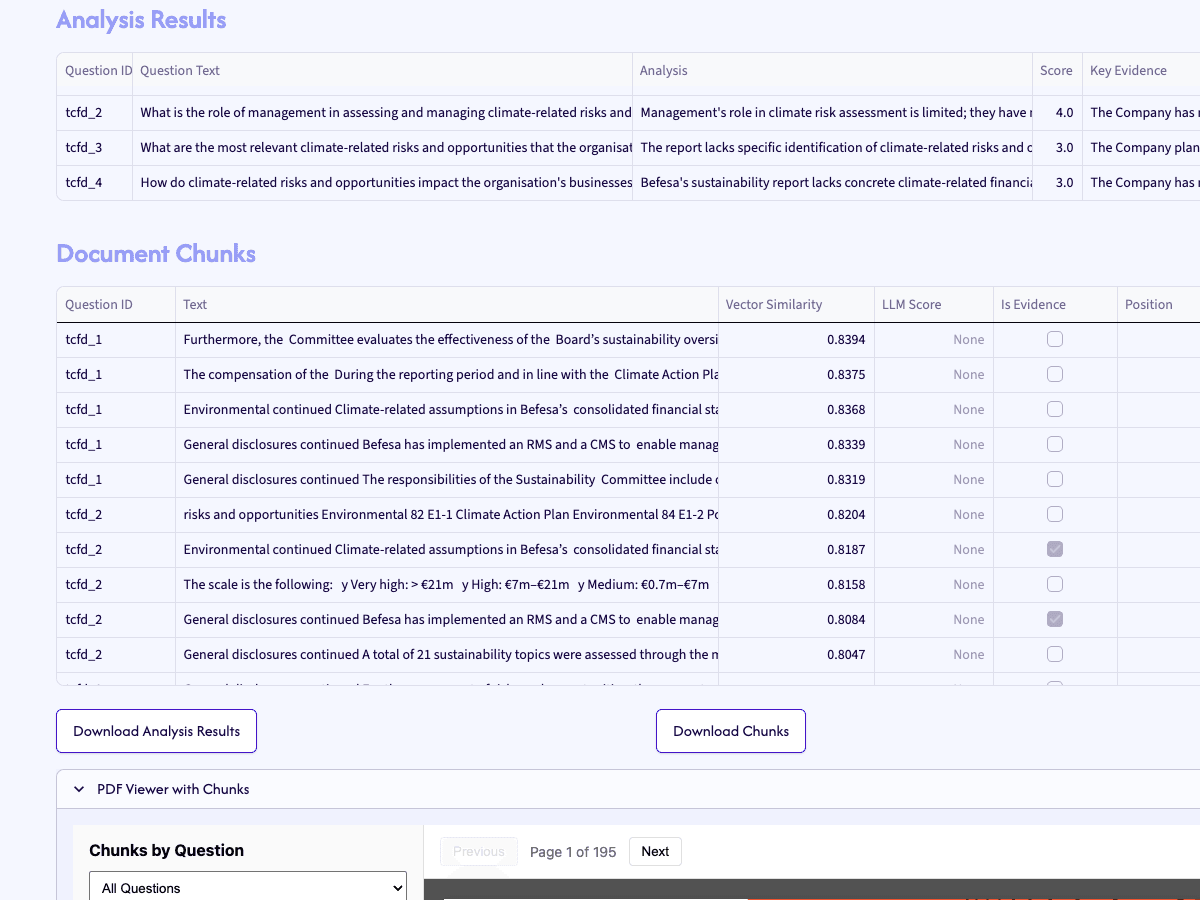
Review scored answers beside their source chunks. Evidence selections stay visible, and both the analysis and chunks can be exported.
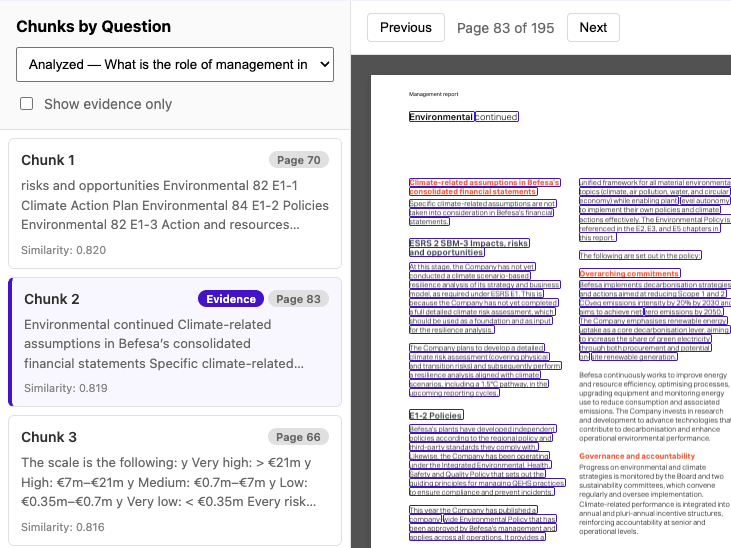
Move from an evidence chunk to the exact PDF page. The matching passage is outlined, making every finding easier to inspect and defend.
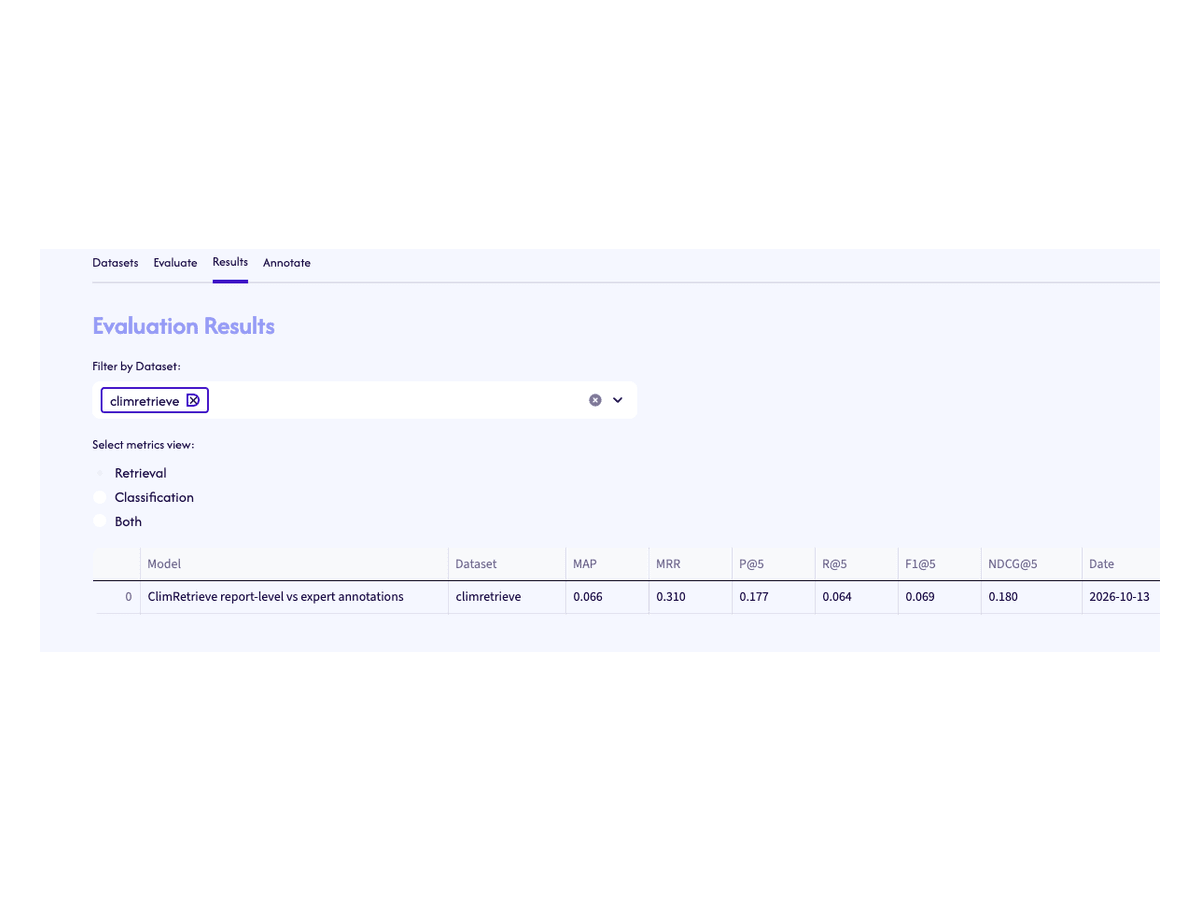
Evaluate configurations against expert annotations with MAP, MRR, precision, recall, F1, and NDCG instead of relying on intuition.
The analysis engine is open source — you can audit every step, extend the pipeline, and run it on your own terms. Enterprise features like API access, managed search backends, and job processing are available separately. Developed with research partners to keep methods reproducible and aligned with current ESG standards.

We work with the Sustainability Reporting Navigator — an academic platform by researchers at LMU Munich, University of Cologne, and others — to integrate expert-labeled sustainability data and benchmarks with OSA's open analysis pipelines.
Read the announcementRun sustainability report analysis with AI on Render or Streamlit — on your laptop, in the cloud, or fully managed. New here? Follow a step-by-step setup guide.
Install locally with a single Docker command. Your data stays on your infrastructure.
Deploy to your own cloud installation in one click. No credit card required.
Need a tailored set-up, integrations, or ongoing support? We work with you to get it right.
Get step-by-step guidance for a managed cloud deployment.
Try OSA now!Part of the Climate+Tech Open Sustainability Analysis Framework. Developed and validated with leading universities, research labs, and funding organizations.


Claude integration
Open Sustainability Analyst can integrate with Claude and add what a chat workflow does not provide consistently: structured, explainable answers linked to report evidence.
A validation sprint compares your pipeline's answers and selected passages with expert-labelled examples, so you can measure quality before scaling it.
Book a validation sprintApplied work
How teams use OSA to structure sustainability analysis, validate evidence, and improve specialised AI pipelines.

Case study · Actwyser
“We were already using Claude for sustainability report analysis, but needed a more reliable way to validate results. With Climate+Tech, we turned our prompt-based workflow into a structured OSA prototype with clear question sets, source validation, and a ground-truth dataset. We can now see where AI helps, where it fails, and how to build a more robust analysis process.”
How we use OSA
As a platform to ensure that our sustainability report analysis meets our quality criteria.
Converted Claude answer policies into OSA question sets and a private prototype.
Compared answer quality, source accuracy, and agreement with analyst judgement.
Checked whether the model found the right passages and where stricter review was needed.
Case study · Score4More + University of Zurich
“We worked with Climate+Tech and University of Zurich researchers to improve how our AI pipeline selects evidence from sustainability reports. By combining real analyst questions, expert labels, and model fine-tuning, we could measure whether a passage was not only relevant, but useful for answering the question.”
Three professional analysts produced 1,061 gold annotations across 15 reports and 64 questions.
Compared retrieval, embedding, and LLM methods on relevance and decision-usefulness.
Improved usefulness classification while identifying a trade-off in model calibration.
Custom model development
Turn your expert criteria and labelled examples into a model for your domain. Climate+Tech helps define the task, prepare the training data, fine-tune the model, and evaluate it against a benchmark before deployment—building on the approach developed with Score4More and University of Zurich.
Discuss a custom modelDeploy Open Sustainability Analyst, connect with the community, or get step-by-step guidance for enterprise installation.
Questions about Open Sustainability Analyst, enterprise installation, or research collaboration? Get in touch.